
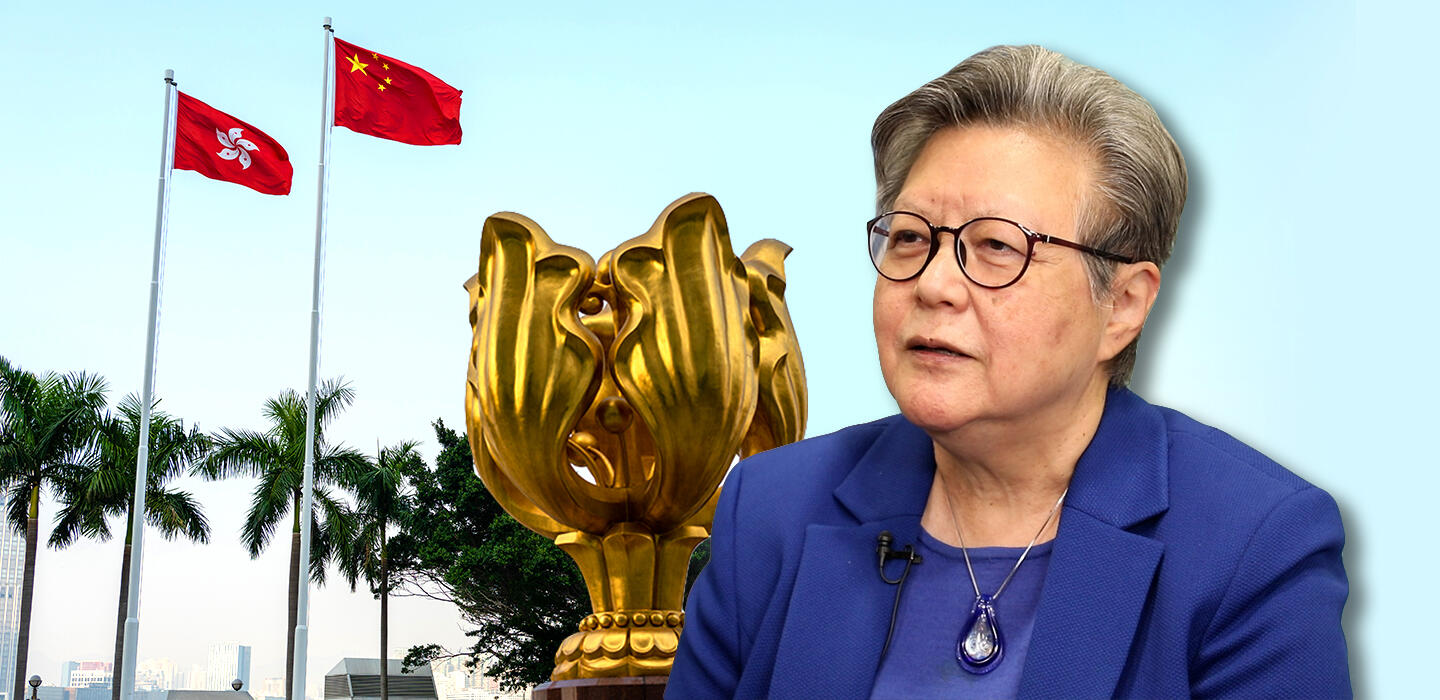
Reality of and Relations Between ‘One Country’ and ‘Two Systems’
播放影片
China is a country that exercises the unitary system. The connection between ‘one country’ and ‘two systems’ was built on the authorization under the ‘two systems’ arrangement. The Central Government delegated the executive, legislative and independent judicial power, and power of final adjudication, to the Special Administrative Region. The previous capitalist system and way of life shall remain unchanged. The SAR government could dispose revenues at its discretion. All laws previously in force shall be maintained except for any that contravene the Basic Law. Hong Kong is not required to bear costs for the garrison force except for defense, foreign affairs, and affairs within jurisdiction of the Central Government. National laws shall not be applied in Hong Kong.
Principle of national sovereignty interwoven in the Basic Law
Does this mean that except for defense and foreign affairs, the Central People’s government has no jurisdiction over Hong Kong?
This is an erroneous perception. In fact, the Basic Law states very clearly in Chapter One the fundamental principle of ‘one country’. Whenever sovereignty is concerned, all powers rest with the Central Government. Article 1 of the Basic Law states, the Hong Kong Special Administrative Region is an inalienable part of the People’s Republic of China. The land and natural resources within the Hong Kong Special Administrative Region shall be state property. The courts of the HKSAR shall have no jurisdiction over acts of state. Article 10 states, the red flag with five stars is our national flag, the images of five stars and Tiananmen form our national emblem, while Article 12 states that the Hong Kong Special Administrative Region is a local administrative region directly under the Central People's government. Only with assistance or authorization from the Central Government can Hong Kong sign mutual legal assistance agreements with foreign countries.
‘One Country, Two Systems’ is a complete concept
Some believe that after the Handover, the growing influence of ‘one country’ has limited the space for ‘two systems’.
These people failed to take “One Country, Two Systems” as a complete concept and neglected ‘one country’ and have overstressed ‘two systems’. A high degree of autonomy does not equate to complete autonomy. The Chinese government has sovereignty over Hong Kong. The Basic Law grants a high degree of autonomy to Hong Kong. The HKSAR enjoys only the powers delegated by the Central Government, no more and no less. The powers are also stipulated by the Basic Law and the SAR does not hold any residual power.
How to ensure the smooth, long-term successful practice of the ‘One Country, Two Systems’?
State leaders have always stressed to ensure ‘One Country, Two Systems’ is fully applied in Hong Kong without being bent or distorted. So, how do we ensure the smooth, long-term successful practice of ‘One Country, Two Systems’?
‘One country’ is the precondition for the implementation of ‘two systems’. When communication between “two systems” is strengthened, and when mutual respect and trust is established, the practice of ‘One Country, Two Systems’ can could embark on the right path.
相關影片
x
教學影片下載表